
The Dignifying Jobs for Women in Construction (DJWIC) Project at SASA Institute of
Industrial Design (SIID) responds to a deep gender gap in construction and Technical and
Vocational Education and Training (TVET). It equips disadvantaged young Ugandan women
with marketrelevant masonry skills, psychosocial support, and pathways into decent work. Thus,
challenging cultural norms that exclude women from construction. Noteworthy, this project is a
partnership between Digital Opportunity Trust (DOT), The Mastercard Foundation, SASA
Institute of Industrial Design (SIID) and Mirembe Community College.
Gender Gaps, Exclusion and Limited Skills.
Globally and across Africa, women are still pushed out of technical TVET and construction. In
Africa, women’s participation in vocational institutions is about 30%, and many TVET fields
remain maledominated and poorly equipped for women (Bahaw et al., 2025). African TVET
systems often reinforce gendered occupational segregation and exclude women from highvalue
technical trades (G. et al., 2026). Women TVET completers frequently face higher
unemployment and earn about 22% less than men, even with similar qualifications, in South
Africa (Friderichs et al., 2024). On large infrastructure projects in Tanzania, women earn about
24% less than men; 66–88% of respondents highlight stereotypes, harassment, and unequal pay
as key barriers (Kitole, 2025).

Within TVET itself graduates in construction often show serious skills gaps in soft, technical,
and tradespecific competencies; average foundational knowledge scores can be as low as 51%
(Bhattarai et al., 2025). In Uganda, TVET is recognised as key for youth employment but is held
back by weak industry linkages and underfunding (Mugaiga & Ocan, 2026). Reviews of
Ugandan TVET show persistent gaps between training and labourmarket needs and call for
systematic integration of employability skills linked to Vision 2040 and SDGs 4 and 8 (Musisi &
Kitagaana, 2025). These structural gaps mirror wider gender inequality in Uganda, where women still lack equal access to training, economic opportunities, and decent work (Asiimwe et al.,
2024). Against this backdrop, DJWIC offers a focused, gendertransformative TVET model in a
maledominated sector.
What the DJWIC Project is About
DJWIC aims to create dignified, decent jobs for young women in construction by:
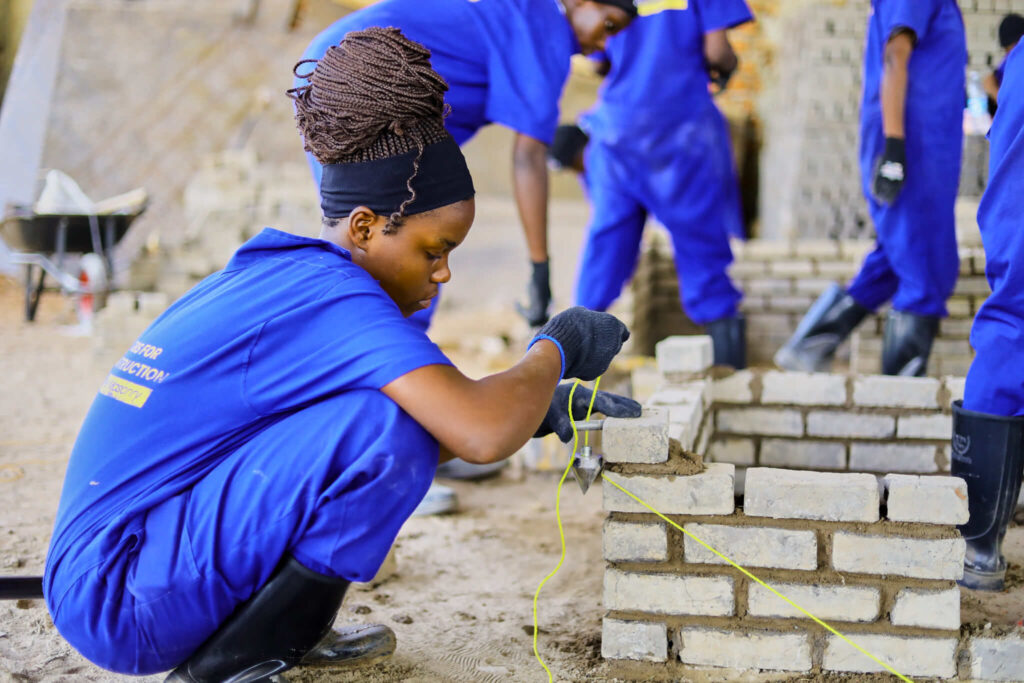
Delivering a Certificate of Training in Decorative Masonry to disadvantaged school
dropouts aged 18–23 from across Uganda.
Equipping them with technical masonry, soft, and business skills to enter formal
employment or selfemployment in a maledominated industry.
Providing holistic welfare, psychosocial support, and safeguarding to address trauma, low
selfesteem, and genderbased risks.
This responds directly to evidence that TVET alone is insufficient: poor women still face
gendered responsibilities, stereotypes, and policy barriers, and need combined skills plus
entrepreneurship and gendersensitive support (Bahaw et al., 2025).
How the Project is Being Implemented
Highquality, intensive training; Cohort One enrolled 50 young women and achieved a
100% completion and graduation rate in March 2026. Training is bilingual (English and
Luganda) to avoid languagebased exclusion.
Full welfare support; Free hostel accommodation, three hot meals daily, medical care,
safety gear, and an upgraded sick bay with a resident nurse are provided to all
participants.
Psychosocial and safeguarding support; Regular workshops led by an experienced
safeguarding champion focus on emotional healing, boundary setting, and workplace
safety.
Industry linked learning; Industrial placements at active construction sites provide
handson experience; several graduates already work as masons. This aligns with findings
from Uganda that industry involvement in practical training and sharing of training
resources significantly improves employability skills (Robert et al., 2026).
Soft skills and entrepreneurship; DJWIC explicitly integrates soft skills and business
skills, in line with global evidence that combined TVET and entrepreneurship education
helps poor women move into sustainable selfemployment (Bahaw et al., 2025).
Community and Stakeholder Engagement
The graduation was attended by senior national TVET leaders and privatesector
executives and was broadcast on national television, amplifying advocacy on women in
construction.
Community surveys show 97% appreciation, 70% rating the project as excellent, 81%
expecting longterm benefits, and 99% supporting continuation.
These results echo wider research that community engagement and safe, supportive
environments are critical to shifting gender norms in TVET (G. et al., 2026).
Achievements
The project has produced:
100 well trained decorative masons from previously marginalised, out of school
backgrounds.
Graduates breaking into a “historically male dominated industry” and “redefining gender
norms in the Ugandan construction sector”.
Individual stories, such as that of Jovia Nankabirwa, show how the project turns early marriage,
school dropout, and family hardship into professional careers in masonry and leadership in the
household economy.
Alignment with Uganda’s NDPIV / National Development Agenda
Recent Ugandan research stresses that TVET and employability skills are central to Vision 2040,
the TVET/BTVET reforms, and SDGs 4 and 8 (Musisi & Kitagaana, 2025; Kenneth & Ahmed,
2026). DJWIC concretely advances these aims by:
Targeting unemployed youth and building practical, entrepreneurial, and employability
skills in a priority growth sector (Mugaiga & Ocan, 2026).
Integrating industry placements and business skills, which directly respond to national
calls for stronger TVET–industry linkages (Robert et al., 2026).
Contributing to Uganda’s commitments on gender equality and women’s economic
empowerment in national gender and development strategies (Asiimwe et al., 2024).
While the provided papers do not describe the NDIV Strategic Plan in detail, the project’s focus
on young women’s employable skills, safe learning, and labour market integration fits squarely
within national TVET and gender equality priorities.
Alignment with Global SDGs and International Priorities
Research links inclusive, genderresponsive TVET directly to:
SDG 4 – Quality Education: Inclusive, equitable, skills oriented education, especially for
women in disadvantaged contexts (Bahaw et al., 2025).
SDG 5 – Gender Equality: Challenging stereotypes and expanding women’s access to
nontraditional, betterpaid sectors (G. et al., 2026).
SDG 8 – Decent Work and Economic Growth: TVET supports decent jobs,
entrepreneurship, and inclusive growth, particularly when it includes women in sectors
like construction (Chola & Kiplagat, 2025).
DJWIC’s emphasis on women’s entry into construction, entrepreneurship training, and safe,
dignified work conditions clearly advances these goals in a tangible, localised way.
Future Outlook: Scaling the Model to Deepen Impact
The project is on track to meet its objectives before September 2026. Cohort Two has already
commenced. Strengthening posttraining followup, identified by 49% of community respondents
as the key improvement area, along with startup capital (36%) and job placement support (35%)
are carefully being considered. These priorities mirror African and global evidence that isolated
training is insufficient; bridging pathways into decent work, not just any work, is essential (G. et
al., 2026).
Informing National and International Practice
DJWIC also offers a demonstration model for:
Gender transformative TVET in male dominated sectors, with strong safeguarding and
psychosocial elements, as recommended by comprehensive African reviews (G. et al.,
2026).
Integrated entrepreneurship–TVET programming for poor women, consistent with recent
Caribbean and Global South research (Bahaw et al., 2025).
Strong TVET–industry collaboration, which Ugandan evidence shows has measurable
positive impacts on graduate employability (Robert et al., 2026).
Given global concern about the “leaky pipeline” for women in construction and the need for
structural support and empowerment (Oladinrin et al., 2025), DJWIC’s outcomes speak directly
to funders, government, and women’s rights advocates seeking scalable solutions.
Conclusion
DJWIC at SIID stands at the intersection of Uganda’s skills and employment agenda, global
SDGs, and the urgent need to close gender gaps in construction and TVET. In a context where
women remain underrepresented in technical training, earn 25% less than men in comparable roles, and face entrenched stereotypes and unsafe workplaces, the project demonstrates that a
carefully designed, holistic TVET model can achieve 100% completion, strong community
backing, and real entry of young women into construction jobs.
By combining highquality masonry training, welfare and psychosocial support, industry
placements, and business skills, DJWIC not only transforms individual lives but also offers a
practical blueprint for gender responsive TVET in Uganda and beyond. Continued investment,
stronger posttraining support, and deeper integration with national TVET and gender policies can
help turn this promising pilot into a sustained contribution to dignified, decent work for women
in construction.
About the Author
Reynold Hillary Tumusiime, MBA, is a Financial Consultant, Educator, and Project
Management Specialist. He holds a Master of Business Administration majoring in Finance and
a Bachelor of Science in Education majoring in Economics. With over fourteen years of
experience in the Banking and Corporate Finance sector, he is adept in Treasury and Risk
Management functions. Currently, he serves as a Lecturer and Project Manager for the
Dignifying Jobs for Women in Construction (DJWIC) project at SASA Institute of Industrial
Design (SIID). He is also a Cybersecurity Research Fellow at Makerere University.