

By Dr Ibrahim Mugerwa, MA, PhD, Industrial Designer, Design Researcher, and Lecturer, SASA Institute of Industrial Design
Introduction
Uganda imports billions of shillings worth of manufactured goods every year—ranging from furniture and household appliances to agricultural equipment, machine components, and construction materials. There is a persistent, frustrating public narrative that Uganda cannot even produce simple, low-tech items like a standard toothpick or a box of matches without relying on imports. Yet, look closely across the nation, and you will find a massive, highly resourceful ecosystem of thousands of skilled artisans, welders, carpenters, and fabricators already producing functional hardware using local materials and sheer ingenuity.
In vibrant informal industrial clusters such as Katwe, Kisenyi, and Nsambya, micro-enterprises manufacture furniture, food-processing machinery, vehicle components, structural fittings, and agricultural implements that directly serve local communities. Pioneers like Musa Body Works and Mukalazi Metal Workshop demonstrate the immense foundational technical skills that exist within Uganda’s grassroots manufacturing sector.
Despite this undeniable potential, many locally manufactured products struggle to capture high-value markets or compete against imported alternatives. This raises a critical economic question: If Uganda possesses the raw fabrication skills and entrepreneurial spirit to build machinery, what is the missing link preventing local products from dominating the domestic market and dispelling the myth of our manufacturing incapacity?
The Missing Link Between Fabrication and Market Dominance
The irony of the Ugandan economy is that while we struggle with the import metrics of minor consumer goods, our local manufacturers possess exceptional mechanical skills and build complex agricultural processing plants from scratch. However, in the modern 21st-century marketplace, commercial success depends on far more than raw functional durability alone. Contemporary consumers evaluate products through a multidimensional lens: appearance, intuitive usability, ergonomic comfort, surface finishing quality, branding, and overall user experience (UX).
A locally fabricated machine or furniture system may be highly durable, but if it is physically uncomfortable to operate, poorly finished, visually unrefined, or difficult to maintain, consumers will instinctively choose imported alternatives. Industrial Design addresses this bottleneck by systematically blending technical engineering performance with human factors, aesthetics, material optimisation, and cost-effective manufacturing parameters.
Lessons from Katwe’s Artisans: The Perceived Value Gap
The structural challenges faced by domestic manufacturers are heavily visible on the ground. A field report documented by the Uganda Radio Network highlighted pressing concerns raised by the Katwe Small Scale Industries Development Association regarding aggressive competition from imported alternative products.
According to the Association, many local property developers and consumers have steadily shifted away from locally fabricated steel gates, windows, and structural fittings, favouring imported aluminium alternatives. While local artisans argued—often correctly—that their welded steel products offered far superior structural longevity and strength, consumers continued to vote with their wallets for the imported options because they were perceived as more modern, visually seamless, and attractive.
This scenario illustrates a vital industrial reality: Product performance alone is no longer enough. Perceived value is heavily driven by design execution. The core challenge facing Ugandan industry is not a deficit in manufacturing capability, but rather the historical absence of systematic product design integration within the development lifecycle. When we fail to apply design, we remain trapped in a cycle where we import the simplest plastic and wood commodities while our own brilliant fabricators are bypassed.
Why Industrial Design Matters to Industry
Industrial Design provides a structured, repeatable methodology for developing products that are simultaneously desirable to users, technically feasible to build, and commercially viable to scale.
- Research & Ethnography: Identifies precise customer pain points and untapped market opportunities within the local community.
- Sketching & Digital Twins: Explore rapid form generation and engineering layouts before a single shilling is spent on raw materials.
- Prototyping & Stress-Testing: Validates component clearances, functional ergonomics, and structural safety before production.
By incorporating factors like Colour, Material, and Finish (CMF) design and Design for Manufacturing and Assembly (DFMA), industrial design reduces material waste, optimises parts for fast local assembly, and instantly elevates the market competitiveness of the finished product—proving that local industry can produce everything from high-end electronics to the perfect consumer package.
Strategic Opportunities for Uganda’s Industrialisation Strategy
Uganda’s current macroeconomic agenda places an absolute premium on rapid industrialisation, domestic value addition, and localised manufacturing. This alignment creates a highly fertile ground for the immediate deployment of professional Industrial Design.
Under the guidance of the Fourth National Development Plan (NDP IV), the government is prioritising agro-industrialisation, import substitution, and the expansion of serviced industrial parks nationwide. Furthermore, the Buy Uganda Build Uganda (BUBU) policy provides a robust regulatory framework designed to encourage the consumption of locally produced goods.
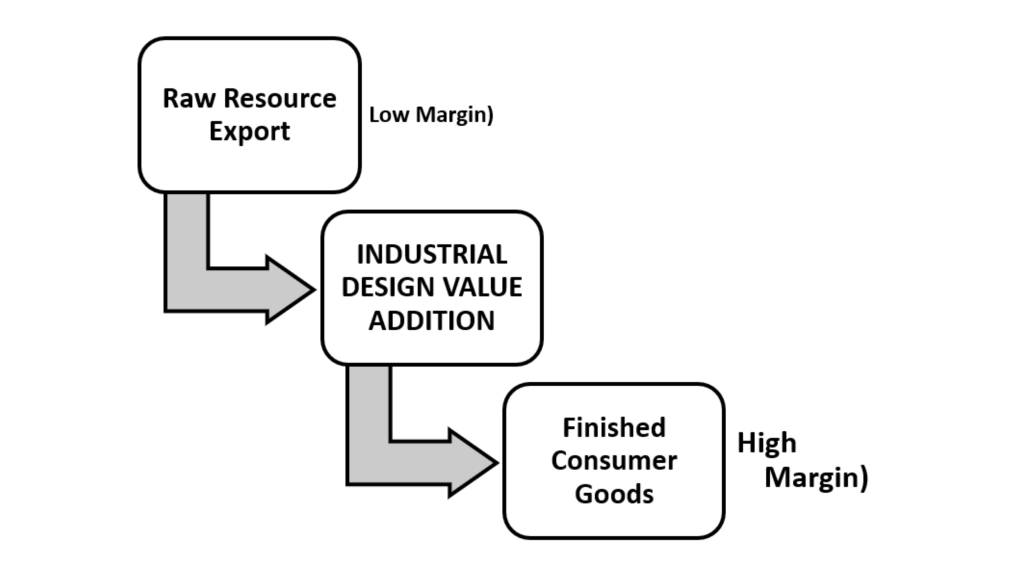
Industrial Design can directly turbocharge these national initiatives. Rather than exporting raw timber, agricultural yields, and mineral ores only to re-import them as finished furniture, processed foods, and hardware, industrial designers allow Uganda to add immense value domestically. By creating high-performing, context-appropriate machinery and consumer goods, local industries can proudly serve domestic needs while confidently expanding regional exports under the African Continental Free Trade Area (AfCFTA).
Building Uganda’s Next Generation of Designers
To fully capture these opportunities, Uganda must intentionally cultivate a new cohort of multi-disciplinary professionals capable of bridging the gap between raw creative draftsmanship, digital technology, and factory-floor manufacturing.
Tomorrow’s Ugandan designers require rigorous training in parametric 3D CAD modelling (such as SolidWorks and Rhino), advanced prototyping, sustainable material lifecycles, and design entrepreneurship. They must be equipped to collaborate seamlessly with traditional mechanical engineers, local workshop artisans, business executives, and end-users alike. Developing this localised capacity requires a deliberate shift toward specialised, competence-based higher education.
The Vision of SASA Institute of Industrial Design
SASA Institute of Industrial Design was explicitly established to serve as the academic and practical engine for this industrial transformation. Mapped strictly to the National Council for Higher Education (NCHE) frameworks, the Institute moves away from purely theoretical instruction to deliver immersive, competence-based training.
Through our state-of-the-art Design–Manufacturing Hub, students tackle live, industry-sourced design challenges. They actively learn how to transform raw conceptual ideas into production-ready, high-fidelity physical prototypes that directly solve real-world problems for Ugandan MSMEs and communities. By injecting highly skilled product designers into the workforce, SASA Institute is directly building the foundational human infrastructure required to replace everyday imports and power Uganda’s manufacturing future.
Conclusion
Uganda already possesses the foundational creativity, technical baseline skills, and raw entrepreneurial energy required to build a powerful manufacturing economy. The critical question is no longer whether we can manufacture products locally, but whether we can design them to command modern market respect.
Industrial Design is the ultimate connective tissue between creative innovation and scalable manufacturing. By making product design an institutional priority, Uganda can confidently elevate local product quality, accelerate import substitution, empower informal artisans, and unlock sustainable, long-term economic prosperity. The future of manufacturing in Uganda will depend not only on what we make, but on how beautifully, intelligently, and strategically we design it.