
The traditional higher education framework which often favours rote content memorisation and theoretical examinations cannot produce the agile, technically proficient, and business-ready professionals required by modern industry. In an era where products are increasingly defined by complex user interfaces, circular life cycles, and rapid technological iteration, design education must evolve.
To bridge the historical gap between classroom theory and the active factory floor, a radical rethink of academic delivery is required. The SASA Institute of Industrial Design has developed a groundbreaking educational model specifically engineered to revolutionise product innovation training in East Africa by embedding students directly into the real world of production.
The Competence-Based Education and Training (CBET) Blueprint
Aligned strictly with the National Council for Higher Education (NCHE) guidelines and mapped precisely to the Uganda Higher Education Qualification Framework (UHEQF), SASA’s curriculum shifts the educational focus entirely from theoretical seat-time to measurable graduate capability.
The program architecture is strictly designed to match national qualification benchmarks: the Diploma in Industrial Design anchors professional training at UHEQF Level 6, while the advanced Bachelor of Industrial Design elevates graduates to full professional leadership at UHEQF Level 7. Across both tiers, students are continuously evaluated on practical execution, technical toolpath mastery, and professional independence. The curriculum structures learning into performance-driven feedback loops where every credit unit earned represents a verified, hands-on workplace competency rather than a simple grade on a written test paper.
Live Practical Lessons with Uganda’s Top Artisans
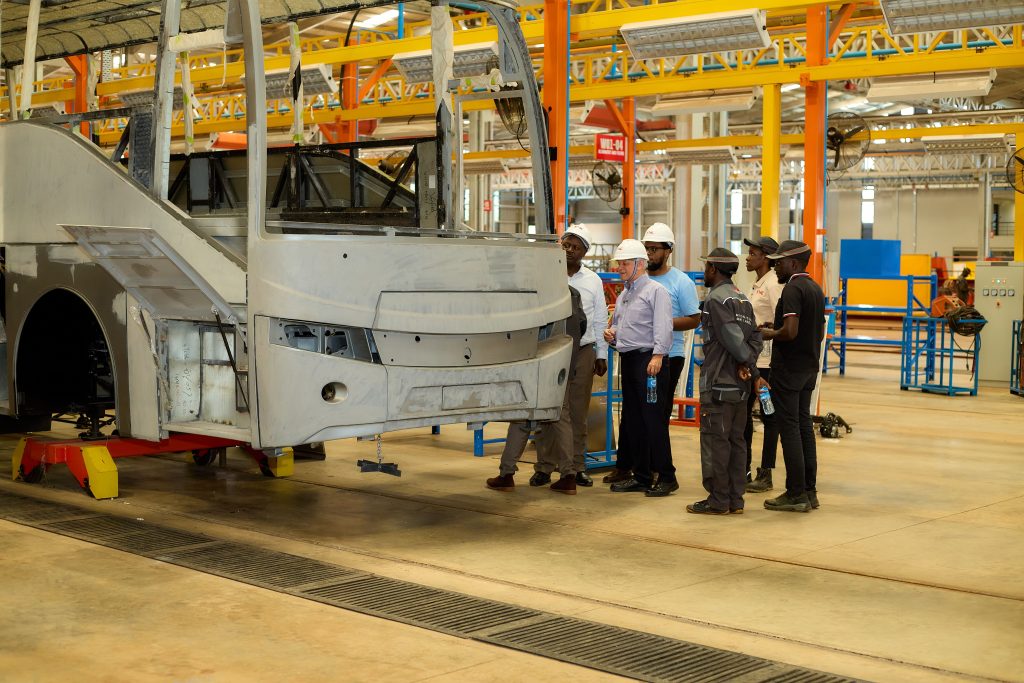
At SASA Institute, learning goes far beyond the boundaries of traditional lecture halls. Through structured, live practical lessons, our students collaborate directly with Uganda’s most experienced informal sector industrial masters and fabricators—including legendary clusters like Musa Body Works and other pioneer workshops in Katwe, Kisenyi, and Nsambya.
By working side-by-side with these seasoned veterans, students absorb decades of deeply rooted, experiential knowledge in metal fabrication, machinery configuration, and structural welding. This direct immersion demystifies raw mechanical engineering and forces students to ground their design thinking in absolute structural reality, appreciating the immense grit and skill driving Uganda’s frontline makers.
The Campus Manufacturing Hub: The Ultimate Proving Ground
To bring these collaborative insights to life, SASA’s educational ecosystem is anchored by our state-of-the-art on-campus Design–Manufacturing Hub. This facility does not function as a passive school lab; it operates as an active, high-gear manufacturing space and a rigorous industrial testing ground for design concepts before they ever head to a factory floor.
Here, students actively transform raw creative sparks into real-world marketplace assets, shepherding their ideas through a strict, professional three-stage product evolution pipeline:
SASA PRODUCT EVOLUTION PIPELINE
| Stage | Activity | Key Processes |
| STAGE 1 | DESIGN CONCEPT | Brainstorming, industrial sketching, parametric 3D CAD modeling (SolidWorks, Rhino, Fusion 360) |
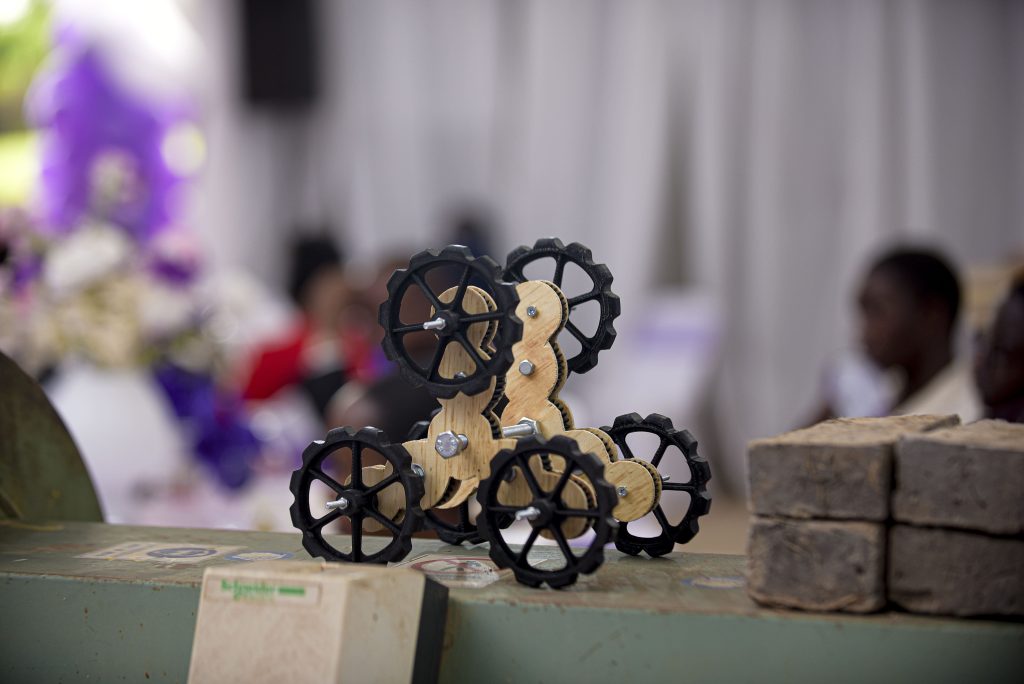
| STAGE 2 | PROTOTYPE | Digital twin simulation, 3D printing, laser cutting, high-fidelity workshop beta builds |
| STAGE 3 | FINAL PRODUCT | Stress-testing, ergonomic validation, material refinement, production-ready manufacturing |
By serving as a dedicated proving ground, the Manufacturing Hub allows students to physically manufacture, stress-test, and perfect their design concepts. They experiment with sheet metal bending tolerances, analyze load-bearing limits, and refine finishing textures. This ensures that every configuration error is caught and corrected during the prototyping phase, saving vital capital long before a product advances to final, large-scale commercial manufacturing.
Strategic Multi-Disciplinary Drivers: CMF, UX, and Design Law
What truly sets a SASA Institute graduate apart is their comprehensive training in the strategic drivers of the modern creative economy. The curriculum deliberately embeds three critical pillars:
- Colour, Material, and Finish (CMF) Design & DFMA: Students study the exact science of surface treatments, texture psychology, and Design for Manufacturing and Assembly (DFMA). This ensures that locally manufactured goods are cost-effective to produce and possess the polished, high-end visual appeal necessary to substitute expensive imported products.
- User Experience (UX) and Ergonomics: Recognizing that modern products are often “phygital,” students are trained to design both the physical anatomy of an object and its digital user interface, ensuring seamless human-product interaction.
- Intellectual Property (IP) and Company Law: True empowerment means ownership. SASA students are explicitly taught how to file utility models, register industrial design protections, patent their original mechanisms, and build viable business models. Graduates leave not just looking for employment, but fully equipped to legally protect their inventions and launch their own design consultancies or manufacturing startups.
Conclusion: Engineering Uganda’s Industrial Future
By blending advanced digital technology, live artisan mentorship, deep manufacturing literacy, human-centred empathy, and robust business strategy, the SASA Institute of Industrial Design is doing far more than just training students—it is building the human infrastructure that will power Uganda’s industrial future.
As the country aggressively pursues economic self-reliance, import substitution, and regional export dominance under the BUBU policy and NDP IV frameworks, our Level 6 and Level 7 graduates stand ready to lead the charge. The classroom of the future is no longer a place of passive listening; it is an active engine of creation. At SASA Institute, we are proudly designing the products, the businesses, and the innovators who will shape tomorrow’s world.